Fantastic Four: A (mildly spoilery) review!

This weekend, Fox released their latest Marvel comic book adaptation, a reboot of the Fantastic Four franchise. The previous two Fantastic Four films weren’t very well received, and Fox was likely hoping to cash in on the post-Iron Man comics boom to change that perception. If so, it didn’t work out as they’d hoped. What follows is a review of the movie, what went right, what went wrong, and where Fox may go from here.

Overall Impressions

The movie wasn’t terrible. Despite what you might read on Rotten Tomatoes, this wasn’t anywhere near the worst comic book movie I’ve seen; it’s not even the worst comic book movie Fox has ever released. For starters, it’s definitely an improvement on the previous Fantastic Four and Rise of the Silver, not to mention Daredevil and Elektra. Having said that, it doesn’t hold up well at all compared to the Marvel Studios movies, or X-Men franchise. If anything, the movie was disappointingly mediocre. Mediocre, because it’s just kind of there: there’s a story, and it occurs, and there’s people and they get powers and they sort-of use them, but by the end of the film, you feel like they never got around to the interesting part. And disappointing, because it could have been better: it’s obvious that there was a much better movie just begging to be released, but we’ll likely never get to see it. Adding to the disappointment is the fact that the trailer promised so much more: whatever movie that trailer was from, I would have much rather seen that than Fantastic Four.

In the end, it wasn’t a complete waste of time — it wasn’t offensively bad coughcoughGhostRider2coughcough. But I don’t really think there’s much of an audience that’s going to be happy to pay for this movie. If you’re a fan of the Fantastic Four, this movie will anger you, and if you’re a fan of superhero movies, it will disappoint you. (For reference: its the first Marvel movie since before Iron Man that I’m not going to see twice, and that includes Thor 2).

Rating: 2/10 (mostly for the acting and the first act); wait for Netflix.

For the rest of this review, there will be some broad spoilers, so if you’re planning to go see it, you might want to stop and come back later. But since you probably aren’t, you can read on…

Read more

The Solarian War Saga

I recently signed up for a trial membership of Kindle Unlimited to find new reading material. Like so many others, I discovered their “100,000s” of books were most ones no one had ever heard of. They have a few stand out series, Harry Potter, Hunger Games, and Lord of the Rings, but the vast majority of their unlimited selection is comprised of titles and authors few have heard of.

On a whim I decided to choose a science fiction series titled The Solarian War Saga by Felix R. Savage.

The first book, The Galapagos Incident introduces us to a future where humankind has spread out throughout the Solar System. The main protagonist is Elfrida Goto, a half Japanese woman who is working on the United Nations Venus Remediation Project. This is an effort to make Venus habitable. They acquire asteroids, load them with some kind of organisms that can survive the 600 degree weather, and crash them into Venus. Elfrida uses remote viewing (think Surrogates 2009) to attempt to acquire asteroids and relocate any settlers who may be already there. Things turn dicey when her remote body’s machine intelligence appears to have its own agenda and goes rogue.

The series tries to imagine a future where technology has taken us to the point of remote sensory, bionic implants, and highly advanced artificial intelligence. These intelligences are so advanced that the United Nations (the supreme authority on everything in this future) has placed bans on just how smart machines can be. This was a direct response to some incident on Mars that resulted in all colonies being lost there and the planet going dark.

The writing might lack a little at times, and the science doesn’t hold up to a lot of scrutiny, but I enjoyed the series none the less. After reading the The Galapagos Incident I continued on to The Vesta Conspiracy, The Mercury Rebellion, and finished with the short story prequel Crapkiller (an ill advised title in my mind). People who enjoy a good space opera might enjoy visiting the future of Felix R. Savage for a few books.

The first book is available for free on Amazon, and the series is available via an Amazon Unlimited subscription (or trial).

Ant-Man: A (mildly spoilery) review!

From the moment it was announced, Ant-Man was viewed as a bit of a risky move by Marvel. Even for a comic book movie, a guy that gets really small and talks to ants seemed like a bit of a stretch. Could they make it work? Would this be the beginning of the end for Marvel?

Of course not. Marvel doesn’t seem capable of making a genuinely terrible movie, and Ant-Man was far, far away from terrible. Following up on epic adventures like Guardians of the Galaxy and Avengers: Age of Ultron, Marvel gives us a small, fun, and funny heist movie that more than delivers.

The short version: 9/10, definite watch, and do so in 3-D if possible. One of my favorite MCU movies yet, largely because it’s something different from what we’ve gotten so far. For more details, keep reading.

Note: There will be very minor spoilers here for some elements of the movie; I will try not to give away anything major, but you may want to skip this one until you’ve seen it. If you’re willing to risk it, click on down:

Read more

Revisiting The Terminator

The film that put James Cameron on the map, The Terminator is quite rightly seen as a science fiction classic, a film that has had enormous impact on modern pop culture thanks to both the lasting impression that The Terminator made and the huge career boost that James Cameron received afterwards. Without The Terminator, I very much doubt that we would have seen the rest of James Cameron’s filmography come to fruition, never mind the number of actors that he has since helped turn into film stars.

The story follows Kyle Reese as he travels back in time from a post-apocalyptic future in which an artificial intelligence known as Skynet has taken over the world. His mission is to protect Sarah Connor from a killing machine known as a Terminator that was also sent back in time to kill her thanks to the fact that she is destined to give birth to the leader of the human resistance.

The time travel mechanic is a creative and tidy way to set the story in motion, and allows James Cameron to hint at the much larger world he has created without it getting in the way of the progression of the story and the momentum that is being built from the very start. It also allows Cameron to easily explain why Kyle can’t call for back up, and why the police and authorities are simply unable to help – it’s a very smart way of ensuring that their is no easy way out for the main characters, keeping them isolated and on the run for the entire movie.

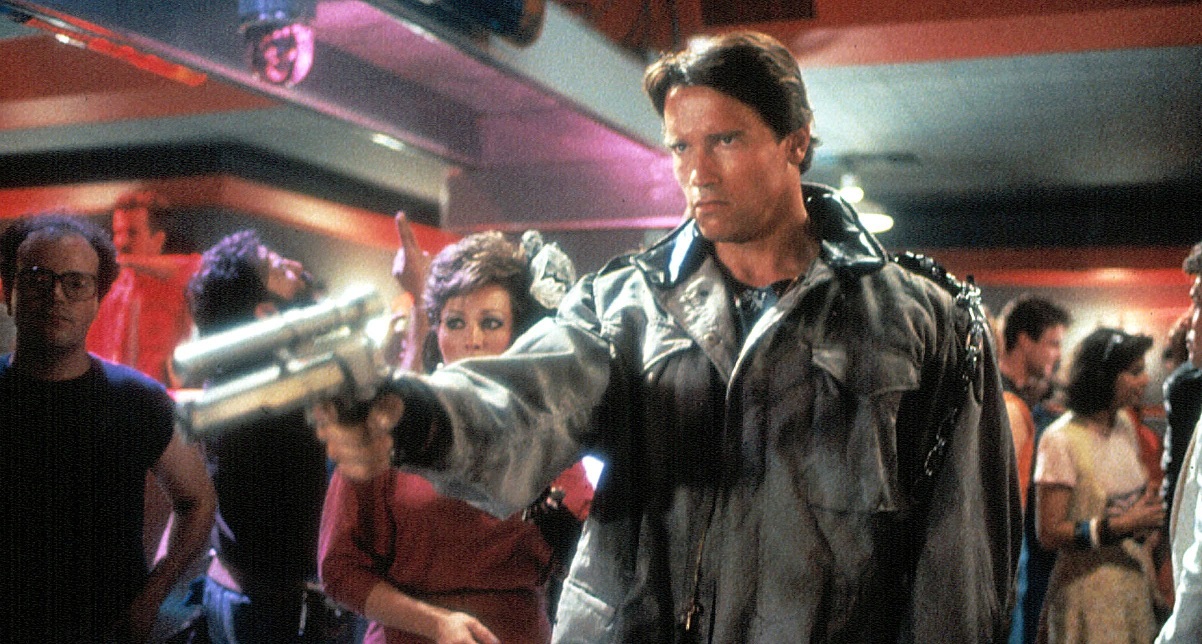
Which is important, because at it’s core The Terminator is little more than a slasher flick with a science fiction flair. The Terminator itself is the ultimate slasher bad guy, a silent, expressionless, intimidating and virtually unstoppable killing machine that is never too far behind our heroes, who are hopelessly outmatched. The best example of this is during the now iconic assault on the police station – even dozens of cops on their home turf can’t do anything to stop the Terminator, really upping the ante and making the Terminator feel as dangerous and unstoppable as it is meant to be, while at the same time showing us how capable Kyle Reese must be to have successfully fought the Terminator off several times before now.

Potentially more important, The Terminator manages to avoid the casual misogyny and conservative politics that are now synonymous with the slasher genre, defining itself as markedly different during a time when slasher flicks saturated the market – no doubt a part of why The Terminator was both a critical and commercial success in it’s time and why it still stands up as a solid piece of film making over 30 years after it’s initial release.

It’s also worth pointing out how well developed the relationship between Kyle Reese and Sarah Connor is in The Terminator when compared to Terminator Genisys, and it’s mostly because of the subtle but important character work that the The Terminator does with Sarah Connor both before and after her first encounter with Kyle Reese. You can understand completely why a vulnerable and scared Sarah Connor would seek comfort in the only man in the world that knows what she is going through, but the equivalent of this in Terminator Genisys is (like everything else in the film) rushed, forced and ultimately unsatisfying.

And the only reason that this all works as intended is because of Cameron’s ability to recognise and work within his limits. His original idea for The Terminator also included a liquid metal robot that would go on to be the primary antagonist in Terminator 2: Judgment Day, but he cut it because he knew that the visual effects available in 1984 weren’t good enough to do the idea justice. This restraint is noticeable throughout The Terminator, which saves it’s limited special effects for important moments and manages to do more with it’s modest budget (just $6 million!) than films that cost upwards of 20 times as much – I’m looking at you, Terminator Genisys.

I still stand by my opinion that The Terminator should never have been a franchise, with the phrase “diminishing returns” very much applicable to the series after Terminator 2: Judgment Day, but that’s neither here nor there – The Terminator is a testament to the importance of inexperienced directors being given the opportunity to prove themselves, showing us the potential longevity of a film when an idea is executed well by someone who knows what they are doing. Even if The Terminator has since been overshadowed by it’s own sequel, it’s still an important and entertaining film that shouldn’t go under appreciated.

For more film and TV review and other articles like this, visit ScreenNerds.

%d bloggers like this: