The Flash – Pilot Episode

The show opens with an 11 year old Barry Allen coming downstairs to see a swirling yellow and red thing encircling his mother. Suddenly he is teleported a few blocks away from his house. By the time he makes it back home, his mother is dead from this mysterious presence.

The Flash

Flash (pun intended) forward to a now 20-something Barry Allen. He is a junior forensics analyst for the Central City police. He’s a scientist (Batman’s a scientist!) and he is excited for the opening of a Star Labs in his town with a new particle accelerator. He ends up missing the opening day and returning to his lab only to see an explosion in the distance (the particle accelerator) and an energy wave pass through the city. Some of the energy collects above his lab and he is struck by lightning, and then rushed to the hospital (who knew to call an ambulance for him? He was alone).

At the same time his adoptive father is running down a lead on a couple of bank robbers who drive a Mustang (product placement). The perps manage to escape in a plane, but not before the same energy wave hits their plane, destroying it and leaving the two presumed dead.

Barry Allen awakens from a coma nine months later and has the abilities of The Flash (i.e. super speed and super reaction time). He works with a few people from the now defunct Star Labs (the explosion really spooked the investors) and not only starts to learn his own abilities, but also learns of the existence of other meta-humans that were created as a result of the particle accelerator gone bad.

When a man who can control the weather starts robbing banks (you might say he is something of a wizard at it) Barry has to decide if he is going to use his newly found powers for good. He has a short conversation with Arrow about it, and ultimately decides to go all super hero and become a vigilante.

Overall I thought it was a pretty decent pilot episode. I’m much more of a Batman fan, but I enjoyed The Flash pilot a lot more than I enjoyed the Gotham pilot. Gotham is apparently all about silly cameos and corrupt cops, while The Flash has a lightheartedness to it that makes it fun. I couldn’t really get into Arrow, but I’m definitely going to be following this sister-series.

Things I noted;

  • The mysterious death of Barry’s mother is obviously going to be a major plot point. Particularly since it makes a viewer think that Barry himself could potentially be responsible.
  • Barry has already revealed his secret identity to five people. This means he tells his secret faster than Batman. I wonder if that will become an issue down the road…
  • We’ve already seen a major antagonist of The Flash perish. Comic Tv shows and movies seem to hate recurring villains, I guess that is why they die so often.
  • The explosion, which potentially affected lots of people, opens the path for many meta-humans to appear in The Flash and in Arrow.
  • We see a news article 10 years in the future which says that The Flash mysteriously vanished during a crisis. Is this the kind of crisis that could span infinite Earths?
Starship Troopers – The Mobile Infantry definitely does not accept Hippies!

Note: The following is a personal review of a book. Please note that the community expert consensus contradicts the views presented in this review. For details, links: #1, #2, as well as comments below.

Starship Troopers is Heinlein’s Hugo-winning right-wing, pro-war, ultra-nationalist (ultra-fascist?) manifesto masterpiece.  Set against the narrative backdrop of boot-camp and interstellar war, Heinlein describes what his ideal military, and by extension future society, looks like.  In Troopers, Heinlein’s paternal characters explain that “might makes right” is the only true moral code and every other point of view is selfish delusion.  At the start of the story, humans live in utopian bliss due to having discovered, and forced to accept, the greatest possible form of government: Democracy where only veterans can vote.

Written after the Korean War, but before the Vietnam War, Heinlein posits the probably naive view that volunteer soldiers are the least corruptible and most moral members of a society.  Non-veteran civilians, on the other hand, are considered unworthy childish scumbag sheep who never had the courage or moral fiber to become true men and women.  Did I mention that Heinlein goes on a 3-page rant about how social-workers and child-psychologists are “pseudo-professional and pre-scientific”, and their notion of not beating your kids (and also not allowing juvenile delinquents to be beaten by the government) led to the downfall of the US before the end of the 20th century?

When ST isn’t explaining why genocide is good, Heinlein is discussing in meticulous and fascinating detail his vision of a perfect military and the awesome array of weapons the Mobile Infantry employs throughout the universe.  One gets the sense that many of today’s sci-fi war franchises, like Warhammer 40K, Battletech, and StarCraft borrow heavily from the torrent of technologies and brutal ideologies that Heinlein presents.  Indeed Warhammer 40K’s ultra-violent Space Marines seem to spring directly from the Mobile Infantry, especially their battle armor, jump-jets, drop pods, and callous ethos.

The Mobile Infantry are soldiers in armored mechanized battle suits equipped with an automatic movement and jump-jet control system, as well as sophisticated communication and sensor equipment.  Each suit has a lengthy array of weapons from hand flamers and rocket launchers to chemical and small-scale nuclear weapons.  This makes the two main battle scenes that bookend the novel graphically entertaining and often thrilling.  Sadly, the couple of other battle scenes are only vaguely mentioned with minimal detail.  One gets the sense that Heinlein only created the two large battle scenes so that he could begin his thinly veiled lectures on his socio-political philosophy and to describe his ideal military.

Heinlein´s Terran military is described in wonderful and intriguing detail.  Though, at times like when Heinlein details the chain of command or the wide variety of possible patrol routes, these descriptions become tedious and down-right boring.  That’s not to say this isn’t a true sci-fi story, it is, but the attention to detail on military matters at times feels more like a distraction. Certain parts stand out, only enlisted men who have proven themselves in battle can become officers, only retired military can vote (no civilians or active military), a small military force comprised entirely of fighting men (no army barbers). The military is hard to join and easy to quit. The book goes out of its way to state this numerous times, and extol the virtues of a volunteer army.

The book has spread to comics, anime, animation, and a film series. In the last few years there has been talk of remaking a Starship Troopers film which will be closer to the books than the 1997 film.

This entry was originally written by markrogers in September of 2011, but was abandoned and placed in a state of limbo. I recently read Starship Troopers and remembered this entry. I decided to finish it and allow it to be published. The title and all but the last two paragraphs are virtually untouched from markrogers’ original draft. – Jack B. Nimble

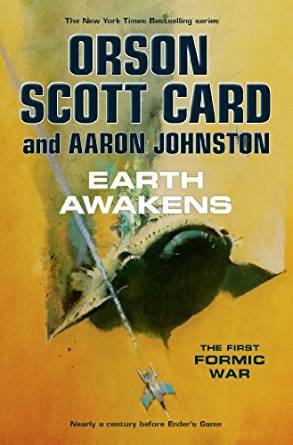
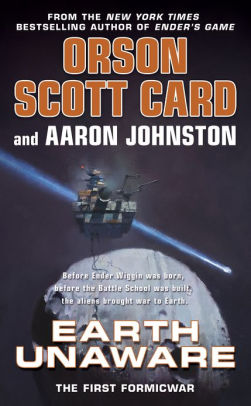
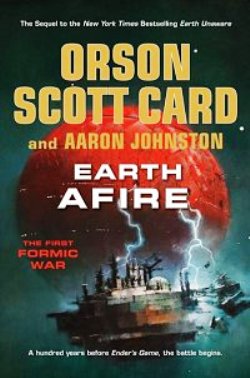
The First Formic War (Ender’s Game Prequel Trilogy)

The First Formic War is a trilogy (Earth Unaware, Earth Afire, Earth Awakens) set in the Enderverse leading up to the first Formic invasion.

I was both excited and afraid when I found out there would a prequel trilogy about the initial Bugger (Formic) invasion. I was excited because I love Ender’s Game. I didn’t get too much into the Shadow series, but I’ve read all of the novels directly involving Ender repeatedly. I was afraid because I hate prequels. It seems to me that every prequel in existence tramples on existing canon. I don’t know if it is because authors are incapable of reading their own source material, or too blinded by the dollar signs, but they can’t keep their stories straight.

The First Contact

Ender’s Game spells out the first contact story pretty well. Eros (the Asteroid) suddenly blacks out, a team is sent to investigate, and they are subsequently murdered by Buggers. I really expected this story to play out in the first book. Therefore I was quite surprised when it never did. In Earth Unaware, first contact takes place in the Kuiper Belt. It makes sense that it would probably be further out, particularly with the current interest in space mining and expansion in general, but still.

The Terminology

At some point Orson Scott Card decided not to use the slang term Bugger and instead always use Formic. The term Bugger does not exist in these books, nor in the Ender’s Game movie. I feel that is very strange. It is in our nature to label our enemies with derogatory or otherwise slang names. And yet other than the novel Ender’s Game and Speaker For the Dead, people are very careful to always use the technical term.

The Technology

My number one issue with the books is their introduction of what eventually will be called the Little Doctor (or MD Device). It is clearly started in Ender’s Game that the Little Doctor came after the second invasion. This is further backed up in Ender In Exile when Ender discovers the Little Doctor is actually a result of an uncontained faster-than-light drive, which humans got from the Buggers. It is stated by Ender and Mazer that up until the start of the third war, they were using nuclear missiles as their primary space-based weapon. So it is frustrating to read about the Little Doctor being developed before the Buggers arrive.

In contrast, the introduction of what becomes ultimately becomes the Battle Room gear is a nice touch. It shows that humans were developing these devices for the military already, and they just adapted it later for Battle School.

The Action

The problem with prequels is that if you are going to include a character who shows up later (such as Mazer Rackman) you know that character is going to make it. There are several times throughout the books where he is in trouble, and to me, these are wasted pages. You can’t kill a character who is going to show up later, so there is no suspense. Mazer has a love interest that he has to leave because of his duty to the military. Is this a heart breaking moment? No, because we know from Ender’s Game that when Mazer left in hyperspace to jump forward in time, he left behind a wife and family. It is hard to get anxious about events that you know are going to work out.

The new characters were all more interesting to me. Because there isn’t anything keeping them alive. An interesting character in a bad situation will peak my interest. An essentially invincible character (from a future story point of view) on the other hand is less interesting (I’m looking at you, Superman). The tension comes because sometimes interesting characters die (unless your name is George R. R. Martin, in which all of them die).

The Summary

These books are okay. The cover credits Orson Scott Card and Aaron Johnston as the writers. Based on the writing, you get the impression it is more of the latter than the former. Everything about the book just doesn’t feel like Card, and I feel like he was more of a consultant than anything else. At no point did I ever stop reading because of the writing (such as with Eragon). They are good stories in there and interesting ideas but they are not great.

I feel like the things which were just briefly mentioned (such as China’s decimation, or the Battle of the Belt) were done well. The more specific the details, the more the prequels seem to feel the need to run them over.

The 100 – Pilot Episode

The 100 is a new CW television network series set in a post-apocalyptic(as if there was any other kind) future.

Set 97 years after a nuclear war has destroyed civilization, when a spaceship housing humanity’s lone survivors sends 100 juvenile delinquents back to Earth in hopes of possibly re-populating the planet. (imdb)


The 100
Kids on the ground

Human apparently survived the nuclear fallout by combining all their space stations into one large one. Because of limited resources extreme population control is enforced. Any crime, no matter how small, results in the criminal being ejected into the vacuum of space. If you commit a crime before you are eighteen, you aren’t killed, but are locked up until you come of age. But even in this totalitarian society, resources are becoming scarce, and the station only has a few viable months left.

Faced with the destruction of the human race, the leaders decide to send 100 juvenile convicts to Earth on a song and a prayer that they will find 97+ year old resources that will save them all. Fortunately a few of the convicts are the children of the leaders, and so appear to have inherited both leadership skills and education. Unfortunately, the other 95 odd teenagers sent down have only read Lord of the Flies and believe that society is a model of success. Up above in the space station, the adults try to monitor the kids’ progress and fight their own political battles.

A few things I noticed about the space station.

  • It has rotating sections for producing artificial gravity.
  • It apparently has the resources to produce new clothing (including leather jackets).
  • It has the resources to build a landing ship capable of holding 100 passengers and with fuel and parachutes to land.
  • It has enough fuel to stay in orbit.

Granted only the pilot episode has aired, but for a station that is running out of resources, it sure seems to have a lot.

No one seems to know much about Earth. I don’t know if this means all the weather and down-looking satellites are gone, or were scrapped for the space station, or what, but they are really going in blind. The primary kid leader takes a small team to look for resources, and makes a comment about there being no animals. Two seconds later they come upon a large buck, only to then see that all isn’t quite right on this nuclear Earth. When night falls some of the foliage glows, which would be a warning sign for any child of the atomic age (or probably a society after a massive nuclear war) but these kids don’t seem to care. In the evening it also starts to rain. The adults monitoring on the station are awestruck at this news. That seems odd to me, since there are orbiting the Earth. Try looking down now and then, people.

Unfortunately I feel like this show is really just a version of LOST set in the future. I became frustrated with the show LOST after 5-6 episodes because the characters weren’t intelligent enough to realize that working together was going to be a lot better than not. This appears to be how things are going to be starting for The 100. Already in the pilot episode we see the 100 breaking into cliques, and the Lord of the Flies taking over. I’m not going to put a nail in the coffin on a single episode, but already I’m leery about what course this series might be taking.


%d bloggers like this: